
Auction Strategy
How to Get Auction Items Without Asking for Donations
The short version: Never cold call for auction items. Cold asks are the slowest and most tiring way to fill an auction. Reserve consignment packages that cost nothing upfront and are paid for only if they sell, have a sponsor underwrite a prize, let your committee host experiences, and save your asking for people who already know you. Most strong auctions mix these.
What Is Auction Item Procurement?
According to HGA Fundraising, auction item procurement is the work of finding, securing, and organizing the items you will sell at your event. Most organizations start by asking local businesses and supporters for donations. That works, but it takes months of soliciting and leans on volunteers who are already stretched. The options below take much of that asking off your plate.
Why You Should Never Cold Call for Auction Items
A cold call asks someone who has never heard from you to give something away for free. The business owner doesn't know your mission or your volunteer, and local businesses hear from many organizations every year. Many of those asks end in a polite no, or no answer at all.
The real cost lands on your volunteers. Someone has to build the list, make the calls, track the replies, and make the next ask after each rejection. In our article on building a procurement system that doesn't start from scratch, we wrote that relying on cold business solicitations is exactly where volunteer fatigue takes root. When volunteers reach out to warm relationships instead, conversations get easier, yes rates go up, and burnout goes down.
Cold calling also leaves your lineup uncertain. If your auction depends on strangers saying yes, you may not know what you have until the last few weeks, when a thin lineup is hard to fix.
None of this means you can never ask anyone for anything. It means you shouldn't build your auction on asks to strangers. Ask people who already know you, and use sources that don't need an ask at all.
What to Do Instead of Cold Calling
Three habits replace the cold call.
Use sources that need no ask. A consignment package needs no solicitation, no collection, and no payment unless it sells. One reservation can replace dozens of phone calls.
Ask fewer people, but warmer ones. Board members, major donors, past item donors, and long-time vendors already know your mission. A single sponsor who underwrites a prize can replace a whole list of cold asks.
Ask earlier, inside an ongoing relationship. Move the conversation off the event calendar and onto the donor calendar. Your best item donors should hear from you in appreciation before they hear from you in solicitation: a thank-you call in December, a mission update in March, and a soft outreach in May, long before a September gala. By the time you ask, you have been in touch several times without asking for anything.
The five ways below follow that order, from no ask at all to a warm ask.
Five Ways to Get Auction Items Without Soliciting
- Reserve consignment packages. A consignment provider lets you offer premium items, usually travel, with no payment upfront. If an item sells, you pay the provider's set cost and keep everything above it. If it doesn't sell, you owe nothing. You can also sell the same package more than once, a technique called selling multiples, to raise far more from a single item. Our guide to consignment auction items explains how it works.
- Build a Vacation Station. Set aside a silent auction category for 6–10 travel packages. It fills a whole section of the room in one move, with no cold calls and no volunteers chasing donations. A couple of packages can also move to your live auction if they fit the room. See the Vacation Station.
- Have a sponsor underwrite a prize. A business covers the cost of a prize in exchange for recognition, such as its name on the signage and mentions from the stage. The prize is paid for before your event starts, and you make one sponsor ask instead of many cold calls. The Golden Ticket Raffle is one way to use this.
- Let your committee host experiences. Dinner parties, game nights, and similar events cost the host time instead of money, and they come from people who already care about your mission.
- Use donations where the ask is warm. Board members, major donors, and long-time vendors are different from cold calls. Most strong auctions use both: donated items anchor the table, and consignment packages add high-value experiences.
Ways to Source Auction Items, Compared
| Method | Who pays upfront | If it doesn't sell | Volunteer effort | Best for |
|---|---|---|---|---|
| Donated by businesses | Nobody | Nothing lost | High: months of soliciting | Local items, silent auction |
| Consignment packages | Nobody | You owe nothing | Low: browse and reserve | High-value travel, live auction |
| Sponsor-underwritten prize | The sponsor | The sponsor has already paid | Medium: one sponsor ask | One headline prize |
| Committee-hosted experiences | The host, in time | Nothing lost | Medium | Social, memorable lots |
| Buying items outright | You | You absorb the loss | Low | Rarely worth the risk |
How to Make a Warm Ask
A warm ask works because the person already knows you. A few habits make it work better:
- Ask for something specific. "Would you donate a two-night stay?" is easier to answer than "Would you like to help with our auction?"
- Tie it to the mission. Tell them what last year's gift made possible, with a real result.
- Make it easy. Put the donation form, drop-off details, and deadline in the first message.
- Offer recognition. Say where their name will appear, such as the bid sheet, the program, or a mention from the stage.
- Say thank you, then follow up. After the event, send a personal note about what their item raised and what it funded.
A sample message (edit freely):
Hi [Name], thank you for supporting [Organization] last year. Your gift helped [specific result]. We're hosting our gala on [date] and building the auction now. Would you be open to donating [specific item]? We'll list your name on the bid sheet and in the program, and I'm happy to handle the details. Thank you either way.
How Consignment Works in Practice
- Browse the catalog and reserve packages. Reserving costs nothing.
- List them in your auction using the provider's photos, videos, and descriptions.
- Run your auction.
- Report your winners. You are invoiced only for the items that sold.
- The provider handles fulfillment for the winners.
An example: Tuscany for 2 has a reserve of $1,995. If it sells for $4,000, you pay $1,995 and keep $2,005. If it doesn't sell, you pay nothing. Sell the same package four times at $4,000 each, and you pay $7,980 and keep $8,020 from that one item.
How to Choose Your Mix
Think of the room in three parts, and settle each one before you pick up the phone.
- The live auction centerpiece. Use consignment for the one or two lots you want at the center of the live auction. These are the items most worth getting right, and they need no asking.
- The silent auction anchor. Use a Vacation Station to fill a silent auction category.
- Local flavor. Use warm asks and committee-hosted experiences for the items that make your event feel like your community.
Reserving consignment packages costs nothing, so you can lock them in while you build the rest of the lineup. That order also protects you: your biggest lots are settled early, and any gaps left are small enough to fill with a few warm asks.
Build a Tracker So You Never Start From Scratch
The fastest way to stop cold calling is to remember who you have already talked to. Keep a shared tracker that lives with your organization, not in one volunteer's memory. Record who was asked, what they gave or why they declined, who thanked them after the event, and when to reach out next. When volunteers turn over, the tracker keeps your warm list alive. Our article on building a procurement system that doesn't start from scratch walks through how.
Common Mistakes
- Starting with the ask. Start with the thank-you. Your best item donors should hear from you in appreciation before they hear from you in solicitation.
- Relying on one source. If everything comes from local businesses, one weak year of asks leaves a hole. Spread your items across several sources.
- Waiting until the last few weeks. Late asks get rushed answers. Reserve consignment packages early and keep your donors warm all year.
- Skipping the thank-you. Every item donor is a relationship worth protecting. A short note about what their item made possible is how next year's ask gets easier.
- Keeping the list in one person's head. Put it in the tracker.
Frequently Asked Questions
How do I get auction items without asking businesses for donations?
Reserve consignment packages, have a sponsor underwrite a prize, and let committee members host experiences. Consignment packages cost nothing upfront, and you pay only for the ones that sell.
What is the easiest way to get high-value auction items?
Consignment. You browse a catalog, reserve at no cost, and list the packages using the provider's materials. HGA Fundraising includes media kits, auctioneer scripts, and marketing assets with every package.
Are there auction items I can get with no upfront cost?
Yes. Consignment packages cost nothing to reserve. You pay the provider's set cost only if a package sells.
What happens if a consigned item doesn't sell?
You owe nothing. Unsold packages are simply returned.
Can I mix donated and consigned items?
Yes. Most strong auctions use both, with donated items anchoring the table and consignment packages adding high-value experiences.
Can a sponsor pay for an auction item?
Yes. A sponsor can underwrite a prize in exchange for recognition at your event. The prize is then paid for before the event starts.
Is it ever okay to cold call a business for an auction item?
It's your decision, but make it your last resort. If you still have gaps after consignment, a sponsor, hosted experiences, and warm asks, ask businesses where someone on your team has a real connection, and ask for one specific item.
How early should I start looking for auction items?
Earlier than your event calendar suggests. Keep in touch with your best item donors all year, with a thank-you, a mission update, and a soft outreach well before your event. Consignment packages cost nothing to reserve, so you can lock them in early.
How do I thank people who donate auction items?
Send a personal note after the event that says what their item raised and what it made possible for your mission.
Get Started
Browse HGA's trips and experiences, or book a free 1:1 coaching call to plan your item mix.
About the author
Jason Ledlow
Chief Executive Officer and Co-Founder
Jason has over 30 years helping nonprofits raise money and coaches multiple nonprofit leaders each week.
You Might Also Like
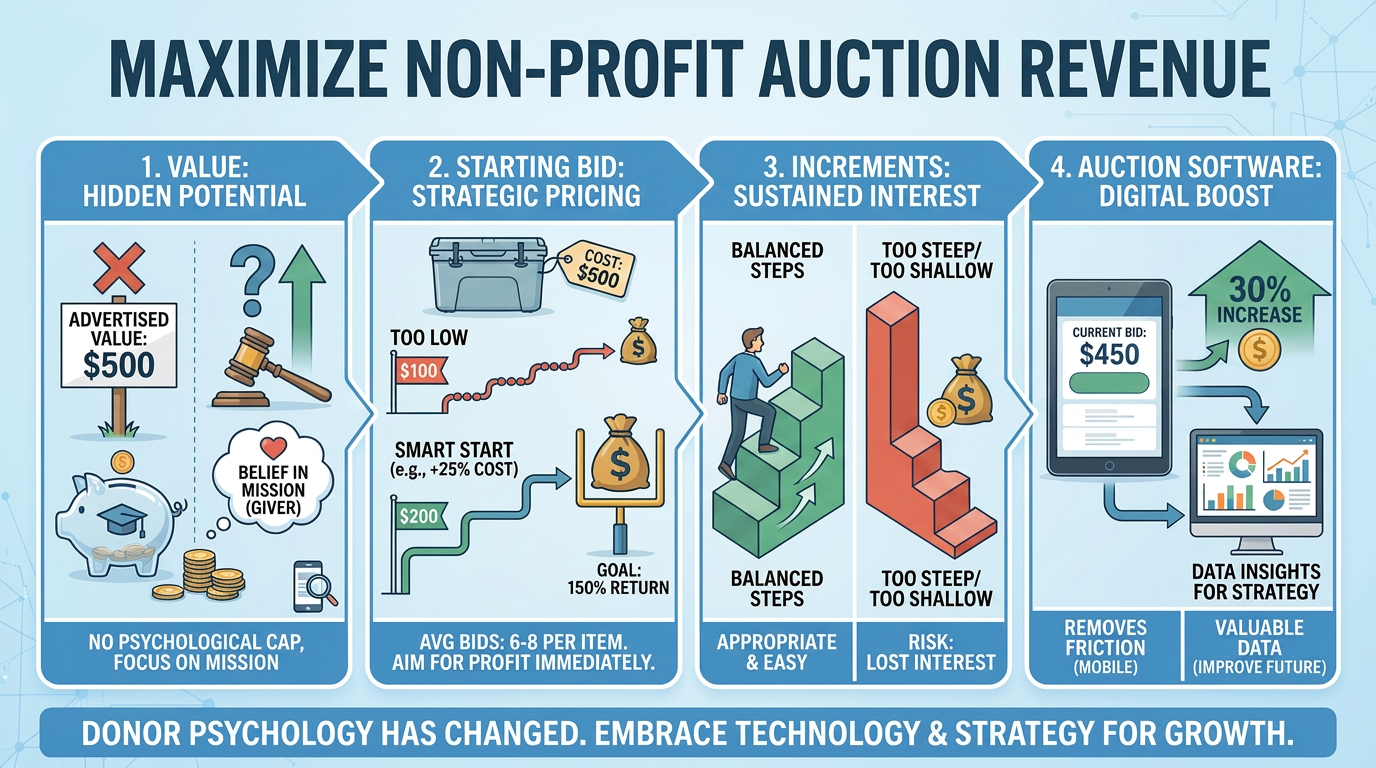
How to Get the Most Out of Your Auction Items in 2026
ValueA good way to increase the money your non-profit makes on live and silent auction items is to not advertise the item’s value.…
Read article
How to Sell Multiples at Your Live Auction (Without Losing Paddle Raise Money)
The 3-step method and one specific phrase top auctioneers use to sell the same live auction item dozens of times without cutting into your paddle raise.
Read articleBook a free session with our CEO.
Browse consignment travel packages for your next live auction.
Talk with our team about your next event.